

Teresa Varley
The Steelers have a rich history, with players, coaches and ownership earning their rightful spot in the Pro Football Hall of Fame for the contributions they made on and off the field.
Many of the Pro Football Hall of Fame enshrinements took place during July, August and September, and we are taking a look back at the day in history that each member of the Steelers organization took their rightful place in football immortality.
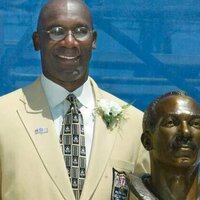
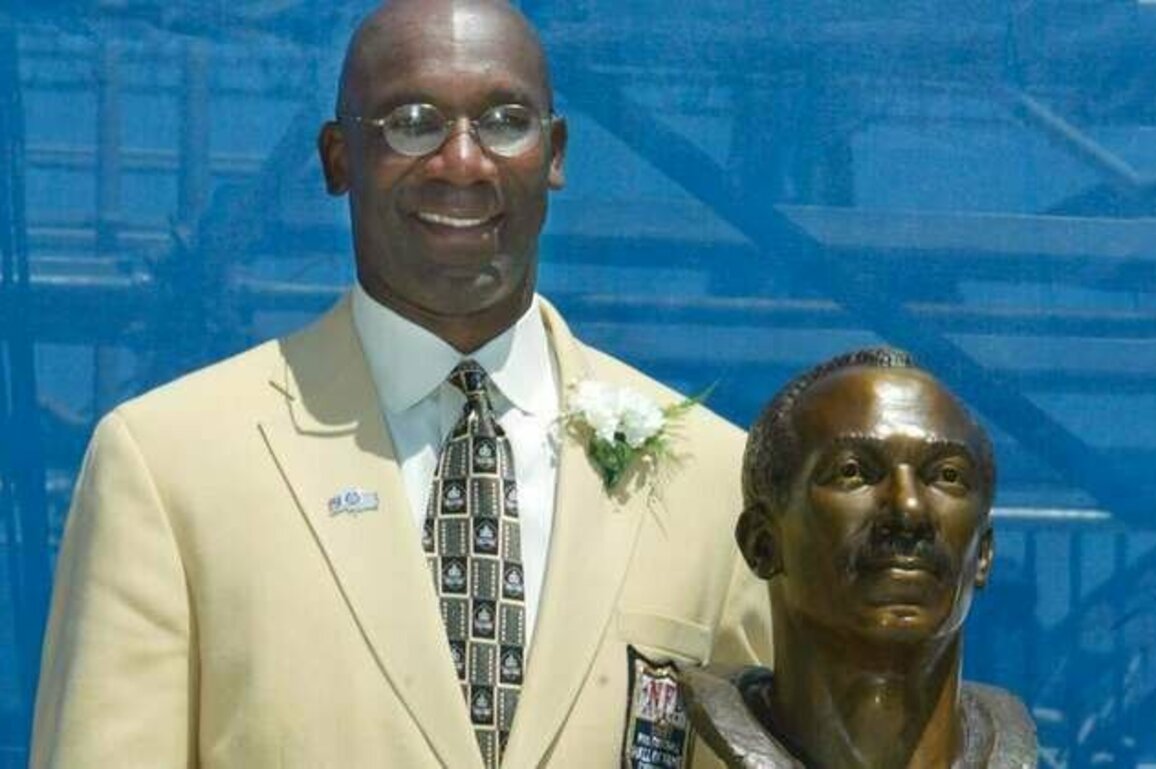
Today, we take a look at receiver John Stallworth, who was enshrined in the Pro Football Hall of Fame on this day in 2002.
John Stallworth
Wide Receiver (1974-87)
Enshrined in the Pro Football Hall of Fame: August 3, 2002
A year after Lynn Swann, his teammate, friend and the man he played receiver with for nine years was inducted into the Pro Football Hall of Fame, John Stallworth got his day in the sun as a member of the Class of 2002.
The previous year Swann spoke about Stallworth deserving to be there along with him.
"He and I battled day in and day out," Swann said of Stallworth during his induction speech. "We competed for that limited number of passes that we knew that we were going to throw every game on Sunday. And, we wanted it desperately. I could not be standing here if it were not for that competitive spirit that I learned from John Stallworth, for his trust and his faith in me as a wide receiver.
"This is, this is the single greatest honor in my life. And, if this is the greatest hour of my life, then I would tell you at this moment, this is only a half-hour. It'll be the greatest hour when I can stand and sit in that back row and John Stallworth is wearing a gold jacket making this speech."
Swann was there the following year when Stallworth completed the hour.
"John probably was a little more physical than Lynn, who was a little more athletic and had the ability to run very well after the catch by making people miss," said late Hall of Fame Coach Chuck Noll. "John would break tackles, then run well after the catch. Both complemented one another. Both helped the running game, also, because in order to have the running game go, to make people respect your running game so you can throw the football, they had to block. They blocked downfield, both of them, very well."
Stallworth, the Steelers fourth-round selection in the historic Steelers 1974 NFL Draft class, caught 537 passes for 8,723 yards and 63 touchdowns, all Steelers team records at the time of his retirement. He also scored one rushing touchdown.
He played in six AFC championship games and was a part of the Steelers four Super Bowl championships and was named team MVP twice. Stallworth was named All-Pro in 1979, All-AFC in 1979 and 1984 and played in four Pro Bowls. He had 12 postseason touchdown catches and 17-consecutive postseason games with a reception.
Stallworth scored the game winning touchdown on a 73-yard reception in Super Bowl XIV against the Los Angeles Rams. Stallworth still holds the Super Bowl record for average yard per catch with 24.4 yards. He also holds the record for single-game average, 40.33 yards, set in Super Bowl XIV. Swann is second in that category with a 40.25 yard average from Super Bowl X, and Stallworth third with a 38.33 yard average in Super Bowl XIII.
During his Hall of Fame acceptance speech Stallworth talked about his first impression of Pittsburgh when he arrived in 1974, and how that changed after the Steelers won Super Bowl IX.
"I've learned that first impressions are not always correct. My first day in Pittsburgh was a mid-winter night right after the draft. It was cold, the trees were barren, it was snowing and I didn't bring a big coat from Alabama. I don't think I owned a big coat.
"And I was going to a team that didn't seem to be terribly thrilled about throwing the football, the kiss of death for a receiver. My first impression of that situation was this is not a good thing.
"Eight months later, I arrived at the airport and caravanned into Pittsburgh after our first Super Bowl win. It was cold. The trees were equally as barren. It was snowing. As a matter of fact, it had been snowing for several days.
"But the difference was there were the people. They were lining the highway from the airport all the way to the city, easily a 20-minute drive. You would have thought it was mid-summer.
"And I came away from that experience with a deep appreciation of the people of Western Pennsylvania. I thank you. I thank you, the people of Western Pennsylvania, for making a Southern boy feel at home for 14 years."
Stallworth is currently a member of the Steelers ownership group.
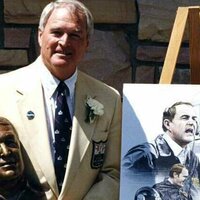
Chuck Noll
Coach (1969-91)
Enshrined in the Pro Football Hall of Fame: July 31, 1993
Charles Henry Noll, "The Emperor," truly was the man who changed who the Pittsburgh Steelers were and continue to be.
When he was hired in 1969, the Steelers were a team that had struggled to win in the past. Prior to Noll's arrival the Steelers had just eight winning seasons and had not won a championship. And even his first season the team went just 1-13.
But it didn't take long for Noll to bring a culture of winning with his style of coaching, a style that was about teaching and developing a group of players who would soon become legends.
Under Noll the Steelers won four Super Bowl championships in a six-year span - Super Bowls IX, X, XIII and XIV.
Noll led the Steelers to 15 winning seasons, nine division championships, and 12 playoff appearances, along with the four Super Bowl victories in the 1970s.
"As for the football end of it, I think he ranks with (George) Halas and (Vince) Lombardi," said Steelers Chairman Dan Rooney Sr. when Noll passed away in 2014. "There are many other good coaches over the history of the NFL, but I think Chuck Noll ranks up there with those other two guys right at the top. No other coach won four Super Bowls, and the way he did it was with dignity. His players were always his concern, both in treating them well and giving them what they needed to succeed on the field."
Noll won 209 games in his 23 seasons with the Steelers, and coached 11 Pro Football Hall of Fame players. And he did it in a manner that is not often seen in sports. He wasn't a rah-rah guy, as his players said he told them they shouldn't need that kind of motivation. He didn't yell and scream. He didn't high-five, hug or embrace players when they made a big play, because that's what he expected from them. But he cared about every player who put on a uniform and went out and played for him.
"Chuck was just the ultimate leader," said Hall of Fame defensive lineman Joe Greene and Noll's first-ever draft pick. "He had truth and belief in what he was saying, and over time all of those things he said were validated, the things about winning football games and being a solid citizen.
"I do know having Chuck as a coach made all the difference in the world in having the career that I had as a Pittsburgh Steeler. I know that early on we went 1-13, and even the year after, when you aren't having success, it's just hard to put any belief in the coach. After a while when nothing is happening positive for you, I was one of those of those guys who said what we are doing isn't working. Why shouldn't we change? But Chuck never changed. We just got better players and followed his instructions better. That's when I became a believer. Somewhere around the third year I started to see that if we did what he said, then we would win. And if we didn't do it then we wouldn't win. And I became a believer, even before we started to win. I saw the consistency in him and became a believer because of what he said and it became clear that how he was coaching us was the right way. In my time I didn't see him hug a player or embrace a player, but he still loved his players. He wasn't one for showing those kinds of emotions. But I watched him, and I saw him show his appreciation for his players and for his team in a very quiet and subtle way."
Noll was a humble man, one who would rather talk about his love of flying than football, and one who never took credit for the success he brought to the Steelers, even when he was inducted into the Hall of Fame.
"The single most important thing we had in the Steelers of the 1970s was an ability to work together," said Noll during his acceptance speech. "The thing that stuck out was we had a lot of people who didn't worry about what somebody else did. If someone else was having a tough time on a particular day, they reached down and got it up a little more. They got the thing done. Whatever they had to do, they did to win. There was never a reason to let down.
"Right now you hear about teamwork and it's defined as 50-50, and that is a falsehood. There's no such thing as 50-50. You do whatever you have to do as part of the team. You may have to carry somebody.
"I can't tell you how much you gain, how much progress you can make, by working together as a team, by helping one another. You get much more done that way. If there's anything the Steelers of the '70s epitomized, I think it was that teamwork."
Jack Ham
Linebacker (1971-82)
Enshrined in the Pro Football Hall of Fame: July 30, 1988
The Steelers selected Jack Ham in the second round of the 1971 NFL Draft and the consistent, steady linebacker played his entire 12-year career in the black and gold.
Ham earned a starting job right out of the gate at left outside linebacker as a rookie after picking off three passes in the preseason finale that year. He held onto the starting role through his entire career, showing his durability by missing only four games in his first 10 seasons.
Ham was named the Football News Defensive Player of the Year in 1975, and was selected to eight straight Pro Bowls. He was named All-Pro six times and All-AFC seven times.
The intelligent linebacker who changed the way the position was played outside, was a key component in the Steelers run to their first championship in Super Bowl IX when he returned an interception 19 yards to the Oakland nine-yard line in the 1974 AFC Championship game to put the Steelers in position to score the go-ahead touchdown and advance to the Super Bowl.
Ham, who played in five AFC Championship games, was a key component during the team's Super Bowl years, and while he played in Super Bowl IX, X and XIII, he missed Super Bowl XIV because of injuries.
He retired after the 1982 season with 25 sacks, 21 fumble recoveries and 32 interceptions to his credit. The combined 53 takeaways are the most ever by a non-defensive back. Ham was All-Pro six times, All-AFC seven times and selected to the Pro Bowl eight time.
He was also named to the NFL's 75th Anniversary Team, the NFL All-Time Team, the Steelers 75th Anniversary Team and the NFL's Team of the Decade for the 1970s.
Ham also earned a spot on the coveted Hall of Fame 50th Anniversary Team alongside linebacker Lawrence Taylor.
Andy Russell, who occupied the middle linebacker spot while Jack Lambert held down the other outside spot, wrote about Ham and a game against the San Diego Chargers in 1975. The Steelers had a comfortable lead, when both players were substituted for to give them a rest. As they stood on the sidelines talking about Ham's involvement in the coal business, the Chargers intercepted and returned the ball to the three-yard. Ham was sent back into the game to try and secure a shutout.
"The first play the Chargers ran was a sweep to the right," wrote Russell. "Bad idea. Ham took their giant tight end, threw him aside, speared the runner behind the line of scrimmage causing him to fumble, which of course Jack recovered. As he slowly walked off the field, he casually flipped the ball to the ref. Returning to our position on the sideline, Jack turned to me smiling and said, 'Where was I?'"
The Steelers won the game, 37-0. The rest, as they say, is history.
Dan Rooney Sr.
President and Chairman (1955-Present)
Enshrined in the Pro Football Hall of Fame: July 29, 2000
There weren't many Pro Football Hall of Famers that were inducted one day, and then back to work for what they were inducted for the next day. But there also weren't many Hall of Famers like Dan Rooney Sr.
Rooney was one of the NFL's most influential owners and a pivotal figure in the growth and development of the league.
Throughout the years Rooney was a member of the board of directors for the NFL Trust Fund, NFL Films, and the Scheduling Committee. He was appointed Chairman of the League's Expansion Committee in 1973, eventually adding Seattle and Tampa Bay to the NFL in 1976.
Rooney was named Chairman of the Negotiating Committee in 1976, and in 1982 he contributed to the negotiations for the Collective Bargaining Agreement for NFL owners and the Players Association. He brought a calm, reasonable approach to labor relations, and was a driving force in the labor agreement again in 1993. Rooney has also been a member of the Management Council Executive Committee, the Hall of Fame Committee, the NFL Properties Executive Committee, and the Player/Club Operations Committee. He served as the President of the Steelers from 1975 until 2003, when he turned it over to his son, Art Rooney II, and became the Chairman.
Rooney chose one of his Hall of Fame players, Joe Greene, to be his presenter for the Hall of Fame, a man he was close to as a player.
"When I was a young player, Dan often had to steer me in the right direction," said Greene during the enshrinement "In my youthful exuberance to win, I was in everybody's business. I was always attempting to tell the coaches what plays to call and telling the players how to play the game. I even had the nerve to tell Dan he needed to get a player signed.
"Whenever I've had a special occasion in my life, the times you want your friends to share, Dan or a member of his family has been there. That means an awful lot. Dan has not only exhibited kindness towards me but has followed in his father's footsteps. All the Steelers players are a part of his family. I am most honored and proud to represent the Rooney family, the Steelers organization, all the former players and coaches, the City of Pittsburgh, and the fans presenting our boss and our friend to the Pro Football Hall of Fame, Dan Rooney."
Rooney then did what he always does when he deflected credit away from himself and put it on to others.
"The players and coaches made the Steelers, and I attribute my presence here today to all of them and to my father," said Rooney in his speech. "My father (Art Rooney Sr.), one of the early men who did everything to make the NFL succeed, it is special to join him here. He gave me the understanding of what the league meant. He gave me the commitment to do everything possible to keep it strong and viable."
And then he encouraged everyone who loves the game of football to do their part to continue its growth and protect it.
"I ask you to be watchful, see that the game remains the best, strong, viable, and flexible for the present day," said Rooney. "No one can be more interested than youth. You have much to guide you. Your own commitment and how you played the game. The people in the league, players, coaches, owners, staff, and fans; the television networks, our family, our players, you have my commitment to do whatever it takes. The National Football League, the game is your legacy. Protect it. Don't let anyone tarnish it."
Since his induction into the Hall of Fame Rooney did what he asked others to do, protect the NFL. He created the Rooney Rule in 2003, which required NFL teams to interview a minority candidate for head coaching and senior football operation jobs.
Rooney, who died on April 13, 2017, also served as the United States Ambassador to Ireland.
Mike Webster
Center (1974-88)
Enshrined in the Pro Football Hall of Fame: July 26, 1997
When you talk about the center position for the Pittsburgh Steelers, the conversation always starts with Mike Webster. A fifth-round draft pick by the team in the 1974 NFL Draft, Webster anchored the Steelers line throughout his career.
Webster started 150 consecutive games, beginning at the end of the 1975 season and lasting until 1986, when a dislocated elbow sidelined him for four games.
Webster played 15 seasons and 200 games with the Steelers, more than any other player in team history. He spent his last two seasons (1989-90) with the Kansas City Chiefs.
He was the Steelers offensive captain for nine seasons, a strong leader off the field and the strongest player on the field, earning him the nickname "Iron Mike."
"Mike wasn't tall enough, he didn't weigh enough, but the thing he had that made the difference was he had great playing strength," said late Hall of Fame Coach Chuck Noll. "You could see it on the field. He would come off the ball with great quickness. I can remember having some films of him against I think it was UCLA, which had these huge, huge tackles. He just destroyed him. Wisconsin moved the ball up and down the field. He not only blocked well on the run, but he also pass protected well."
Webster, a member of the Steelers four Super Bowl championship teams in the 1970s, played in nine Pro Bowls, and was selected All-Pro seven times.
Webster led the way for Hall of Fame running back Franco Harris, and kept quarterback Terry Bradshaw safe. It was Bradshaw who would be Webster's Hall of Fame presenter, and the two shared a special moment on the steps in Canton, Ohio.
As Bradshaw talked about a dream he had as a kid to play on a championship team, he rattled off the Steelers players that helped him achieve that. When he got to center, he spoke of Webster.
"What good is a machine if you ain't got a center? And, oh, did I get a center," said Bradshaw. "I just didn't get any center. I got the best to ever play the game, to ever put his hands on a football. And I said `Make sure he ain't as pretty as me,' and he ain't."
And then Bradshaw fulfilled another dream, the one he had the day he was inducted into the Hall of Fame in 1989, when he said, "Oh, what I would give to put my hands under Mike Webster's butt one more time."
So on the day Webster was inducted, Bradshaw pulled a football from underneath the podium and as the moment happened, Steelers fans, fellow Hall of Famers, and everyone in Canton erupted. Bradshaw took one last snap from Webster.
"Do not be afraid to fail," Webster told the gathered crowd that day. "You're going to fail, believe me. No one's keeping score. All we have to do is finish the game. Then we'll all be winners."
Five years after his induction, Webster died at the age of 50.
Bill Nunn
Scout (1967-2014)
Enshrined in the Pro Football Hall of Fame: April 28, 2021
It's a day many in the Steelers organization, many in Pittsburgh, and many around the NFL, patiently waited for.
And it was a day that was worth the wait.
Bill Nunn, the legendary Steelers scout, was enshrined posthumously, during a special ceremony, 'Hall of Famer Forever,' at the Hall of Fame in Canton, Ohio.
"It's still a little bit surreal for Bill to get recognized like this," said Steelers General Manager Kevin Colbert. "We will finally came to the realization of how great an honor this is and how great an honor it was to know and work with a man like Bill Nunn. Until you really see it happen, it's not a real feel, but you are picking that up now.
"Bill meant everything to the Steelers organization. It's been documented, the players he was instrumental in bringing to the Steelers and the success they had. We as young scouts were fortunate to be around Bill and try and learn things they implemented when they put those teams together. There were a lot of lessons being taught to us."
Nunn, who worked in multiple roles in the Steelers personnel department beginning in 1967 in a part-time role, and then in a full-time role from 1969-2014, was voted into the Pro Football Hall of Fame as a Contributor as part of the Class of 2021, the first Black Contributor in the 100 plus year history of the Pro Football Hall of Fame.
While the ceremony for Nunn's enshrinement was on a smaller scale than what will took place when the remainder of the Class of 2020 and 2021 were enshrined, the emotion, passion and love of the game that Nunn and the others held in their hearts was larger than life and definitely on display.
"He is the first African-American contributor in the Hall of Fame," said then Hall of Fame President David Baker. "I think the heritage of Bill, he is in here already because he is in the Black College Football Hall of Fame. The Pittsburgh Steelers would turn over every stone to find the best talent, the people who were going to be Pittsburgh Steelers, Donnie Shell, LC Greenwood, Mel Blount, all of these guys came from Historically Black Colleges and Universities."
Nunn's granddaughter, Cydney Nunn, did the honors of unveiling her grandfather's Hall of Fame bust. She also assisted in placing his bust in the Hall of Fame Gallery and was given a Hall of Fame plaque, which includes a swatch of the Gold Jacket that is presented to Hall of Famers.
"I know my grandfather probably didn't think he was going to be in the Hall of Fame," said Nunn. "That wasn't necessarily a goal of his. This has been a huge memorable historic time for our family. We are happy we are able to be here to represent his legacy.
"It's incredible he is the first black contributor to be in the Hall of Fame. He made such a huge impact on this sport as we know it, the way he scouted players and how he opened doors for so many black athletes. Also, walking through the museum, seeing him in the Black College Football Hall of Fame, he is so great he is in there twice."
Nunn was a trailblazer who opened the door for so many to have careers in the NFL, in particular those from Historically Black Colleges and Universities.
Nunn, who died in 2014 at the age of 89, joined the Steelers organization in the scouting department after a career in the newspaper business where he started as a sportswriter, then sports editor, and then managing editor of The Pittsburgh Courier.
Starting in 1950 he selected the newspaper's annual Black College All-America Team, developing relationships that benefited his scouting career and opened the door for Black players who weren't getting a lot of attention from professional teams.
The last Black College All-America Team Nunn selected for the Pittsburgh Courier was in 1974, and a member of that team happened to be John Stallworth. Nunn scouted Stallworth, along with other BLESTO scouts who at that time would travel together, on a wet track at Alabama A&M, and the wide receiver didn't time well in the 40-yard dash.
The group was leaving Alabama the next morning, but Nunn said he felt 'ill' and was staying and would catch up with them on the road. What he did, though, was go back and time Stallworth on a dry track and he got the results he wanted. Also, through his relationship with HBCU coaches, he was able to obtain the only game film of Stallworth that existed. He promised to return the film to be shared but never did. The rest, as they say, is history. That 1974 Steelers team went on to win Super Bowl IX, with 11 players from HBCUs, and the Steelers 1974 NFL Draft Class that included four Hall of Fame players in the first five picks Lynn Swann, Jack Lambert, Stallworth, and Mike Webster plus another Donnie Shell as an undrafted rookie is acknowledged as the greatest draft class of all-time.
Nunn, a member of the Inaugural Class of the Black College Football Hall of Fame and a 2018 Steelers Hall of Honor selection, helped the Steelers find talent from HBCUs that other teams largely ignored, including L.C. Greenwood from Arkansas AM&N, Mel Blount from Southern, Frank Lewis from Grambling State, Dwight White from Texas A&M-Commerce, Ernie Holmes from Texas Southern, Joe Gilliam from Tennessee State, Stallworth, and Shell from South Carolina State, who will be enshrined into the Pro Football Hall of Fame this year as a member of the Centennial Class of 2020.
"Bill Nunn has done so much for the league over the years, not only for the Steelers but also when he was a reporter by going to the Historically Black Colleges and Universities and finding all of the talent there and letting the NFL teams know about that talent," said Shell of Nunn prior to the enshrinement. "And what he did for the Steelers. Look at how many players he brought to the Steelers to help build those championship teams.
"We had side conversations that no one ever knew about. He was a confidant. If I had some issues, if I didn't do well in practice, I would talk to Bill and it wouldn't go any further than that. He would sit me down and say keep working hard and doing what you are doing, you will be fine. When you are young, that gave you encouragement to keep working hard. Nobody ever knew about that.
"I don't know if he realized it or not, but just being around Bill, his professionalism, the way he carried himself in his life, it meant a lot to me and had a great effect on me. He never would have thought that. That is the way he was, unassuming. That was Bill. That is who he was. He made people gravitate to him. You wanted to be with him. You wanted to be in his presence to listen to some of the wisdom that he had."
That was the thing about Nunn. He was unassuming. While he would be honored by his enshrinement, he also would have been beyond humbled, and almost embarrassed by the attention because in his eyes, getting others attention was always more important.
"Bill would be the last one to be seeking any kind of attention," said Colbert. "That's was just his makeup."