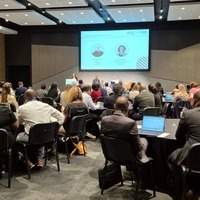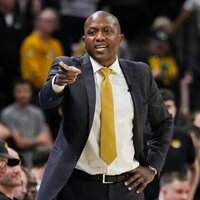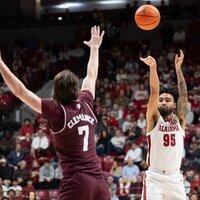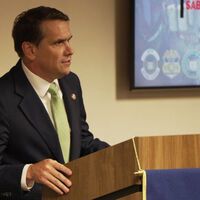



(CN) - With a newly appointed judge presiding over the case, attorneys representing Alabama basketball player Charles Bediako appeared in a Tuscaloosa County courthouse Friday to argue against NCAA eligibility rules that have prevented Bediako's return to the University of Alabama roster after he left for three years to play as a professional.
On Jan. 21, Judge James "Jim" H. Roberts granted a temporary restraining order in Bediako's favor. The 23-year-old, 7-foot-tall center has since played in four games, including two won by Alabama.
Shortly after, though - on Jan. 28 - Roberts recused himself after the NCAA cited conflicts of interest due to Roberts' donations to the University of Alabama athletic fund.
The case is now being overseen by Alabama Circuit Court Judge Daniel F. Pruet. Early in the hearing on Friday, Pruet noted he had little to no knowledge of how "name, image and likeness" (NIL) rights and proceeds work in collegiate sports.
Pruet urged the parties to explain how Bediako is different from other pros who have returned to college.
He also asked them to define the NCAA rule blocking Bediako's eligibility. The NCAA cited its "four and five" eligibility rule, which means players are eligible for four seasons of competition within a five-year period.
Representing Bediako, attorney David W. Holt said the NCAA's stated rules barring professionals from college sports are applied in an arbitrary and inconsistent way and that his client was being unfairly singled out.
Dozens of former professional players are currently on Division I rosters, Holt said, including in the Southeastern Conference. He also noted that several had more professional experience and higher pay than Bediako, yet they remain eligible while Bediako is not.
"The only distinction between Mr. Bediako and any of these other former pro athletes is the fact that he spent two years in college before he tested the pro waters," Holt said. "From our position, that's a distinction that has no real meaning."
Holt suggested Bediako was interested in returning to college to complete his education after he suffered some injuries in the NBA's G League and realized his professional career may be limited.
He acknowledged Bediako has a NIL contract with Alabama but said money is not a motivating factor and stressed Bediako is not taking a roster position away from other eligible players. Holt disclosed that Bediako earned roughly $530,000 in his three years in the G League.
"If this injunction isn't granted, Mr. Bediako may never have the opportunity to compete again," Holt said. "He'll lose any opportunity - as a student, as an athlete, or any potential employment."
NCAA attorney Taylor Askew said it was okay to sympathize with Bediako. Nonetheless, he said the court's job was to apply the NCAA rules that member schools themselves created and agreed to - not to rewrite them on behalf of one player.
Alabama initially determined Bediako was ineligible, Askew noted. He said the NCAA merely agreed with that determination under the existing bylaws and waiver criteria.
"These are hard cases," Askew said. "It's not something that is exciting to do, to look a young man in the eye and say, 'You know the rules just don't permit you to play.' But this is not a court of emotion; it's a court of law."
Askew also suggested that Bediako's motivation is in fact money.
"He came back to school from the G League to make money," he said. "This is not a case about whether Mr. Bediako is going to play basketball again. It is [about] where he is going to play basketball."
Askew warned about the kind of precedent a ruling in Bediako's favor would set.
"What's at issue here is judicial decrees that say, 'Well, this doesn't necessarily make sense, so I'm going to strike down this rule,'" he said. "In this case it's even more egregious, because to allow Mr. Bediako to play, you're striking down multiple rules on no record, with no critical analysis. What do we see? Fifty more lawsuits, and everyone says it'll be chaos."
On rebuttal, Holt said the only bar the judge has to reach for an injunction is showing Bediako has a "reasonable chance" to succeed on the merits. He also highlighted Bediako's antitrust and breach of contract claims.
"The studentathlete reinstatement guidelines say that if an enrolled studentathlete signs a contract or accepts a salary, the presumption should be permanent ineligibility," Holt concluded. "That's not an absolute bar. That gives the NCAA discretion. When you have an athlete like Mr. Bediako with no real practical distinction from all these others who are playing, that's when you see the rules applied arbitrarily."
Unranked Alabama faces its cross-state rival Auburn University in Auburn at 3 p.m. Saturday. Pruet asked both parties to submit draft orders by the end of the day and suggested he would make a timely decision.
Source: Courthouse News Service